12/09/2008

Samgyetang 삼계탕 (Chicken soup with ginseng)


Samgyetang(삼계탕) is a piping hot dish.
We eat this soup some special day in summer. We called Buk-day(복날).
According to the logic of overcoming heat with hot things,
Koreans believe that in hot weather they should eat hot foods to maintain their health.
For this reason you may be able to see long lines of customers
outside Samgyetang restaurants on the hottest days of summer.
Ingredients :

1 small chicken (Cornish hen)
3-4 roots insam (jinseng)
5-6 bam (chestnut)
6-7 daechoo (jujube)
1/2 cup glutinous rice(sticky rice)
8 cloves garlic, peeled
1/4 inch piece ginger, peeled
salt, pepper
Photobucket
How to Cook :

Clean the chicken inside and out.
Trim any visible fat as much as possible.
Wash rice, jinseng, chestnut and dae choo (Chinese date).
Stuff inside the chicken with rice and seal.
In a pot, add chicken, jinseng, Chinese date, chestnut, garlic and ginger.
Pour water to cover the chicken.
Bring to a boil and turn down to simmer.
Cook about 2-3 hours until the bones fall apart.
Skim out the fat on top occasionally.

Photobucket

Photobucket


Tip :

You can buy "Samgyetang Package" contains all 4 ingredients in Korean market.

12/07/2008

Culture Capsule 2

A few Korean question you might misinterpret.

You may have heard the question "Have you eaten?" when running into a Korean friend on the street. Do not be confused if your friend just smiles and keeps walking even if you say you have not eaten.

Misunderstandings can occur in this situation because the korean implication of this question is different from it's literal meaning. Usually when Koreans ask whether or not you have eaten, they do not want to talk about food. "Have you eaten?" is just a typical way of greeting people. So, even if you answer that you have not eaten, Koreans may not invite you for a meal. When asked this question, it's fine to just say "yes".

Another korean greeting that may create misunderstanding is "Where are you going?" In this case too, Koreans are being friendly, but not necessarily curious about you destination. For this reason, you can answer simply by saying "yes" and you are not obligated to give a specific destination.

** Think about whether there are similar questions in your country.

-Write reference Korean Languge Education Center, Sogang University

12/06/2008

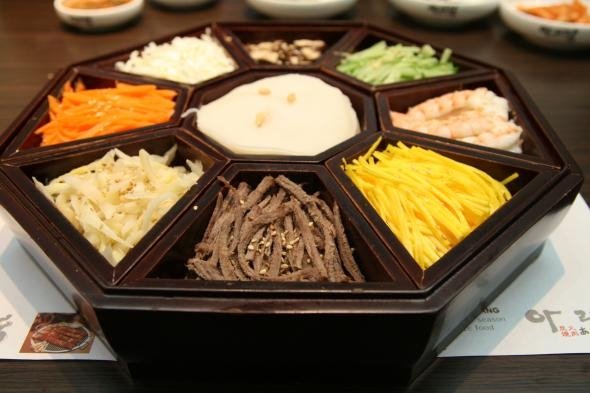
구절판‏ Goo Jeol Pan ( Crepes With Eight Stuffings)


Goo Jeol Pan or Crepes With Eight Stuffings is Korea's traditional food. In the olden days, it used to be one of the Royal Food. And, can be eaten only by the King and the royal family.

Photobucket

Ingredients :

1/2 cucumber
1/2 carrot ; thin juliennes
1/3 lb of beef ; very thin strips
1/3 lb of bamboo shoot ; thin juliennes
4 oz of seok ee mushroom ; thin sliced
3 eggs

flour
salt
pepper
sesame seed oil

Beef Marinate:
1 teaspoon of soy sauce
1 teaspoon of sugar
1/2 teaspoon of sesame oil
1/2 teaspoon of minced garlic

Shiitake Marinate:
1/2 teaspoon of soy sauce
1/2 teaspoon of sesame oil
1/4 teaspoon of sugar

Gyeoja Sauce:
2 tablespoon of Korean mustard powder
1 tablespoon of water
1 tablespoon of vinegar
1/2 tablespoon of sugar

Kanjang Sauce:
2 tablespoon of soy sauce
1 teaspoon of vinegar
1 teaspoon of wasabi

Photobucket

-Put the marinated beef and shiitake mushroom in a pan, then sauté .
-Cut the cucumber into 1.5 inch length. We need thin julienne of the outer green part of the cucumber.Use a knife to peel the outer part of the cucumber for about 1/8 inch thick. This is a tricky part, be careful with your hands !
-Then, make julienne out if it. Saute in a pan with a little bit of salt. Saute mushrooms, carrot and bamboo shoot separately with some salt. Separate eggs, add some salt and make "Ji Dan" (thin crepe).
-Cut into 1.5 inch length ; very thin strips.
-Combine flour, salt, water and make a very light batter.
-In a non-stick pan, put 1 tablespoon of vegetable oil and wipe out slightly with a paper towel.
-Pour 1 small ladle of batter, and make a very thin wrapper ; flip once.
-There are special serving plate for this dish in Korea. However, you can arrange them in a big plate and leave the center for wrapper.
-Serve with gyeoja sauce and kanjang sauce.


Tips:

These wrappers are hard to handle.They are easy to break, stick together, and do not taste good if made thick. So be patient and do some practice, and do not overlap until they are completely cooled !

You can substitute with very thinly sliced radish.
Pickle it a day ahead in the same amount of rice vinegar and sugar (add some salt).
Drain it.
You don't have to prepare all eight stuffings.
The simple version is onion, squash, cucumber, and carrot.

This dish can be a vegetarian menu by simply taking out the beef.


Step-by-Step in how to eat Goo Jeol Pan !


Photobucket

Photobucket

Photobucket

Photobucket

Photobucket

Photobucket

Photobucket

Photobucket

12/05/2008

Janchiguksu 잔치국수 (Noodles with vegetables in dried anchovy broth)

Janchi guksu is a Korean noodle dish consisting of wheat flour noodles in a light broth made from anchovy and sometimes also dasima (kombu).

It is traditionally treated to food when they came to the birthday party or wedding party.

So the name is Janchi(=Party).

Noodle is one of long food.

It has a meaning. To blessing for longevity and keeping for happy marriage life for longtime.

In Korea, we ask to someone(the marriageable age), “Do you have a plan that give a noodle to us?”
That’s a same meaning.

Photobucket


Ingredients:

2 bundles somyon noodle
1/4 cup myeol chi (dried anchovy)
1 3x3 kelp piece, 1/2 onion, thin sliced
1 egg, 4 ounce beef
soy sauce, sugar, minced garlic, sesame oil, salt and pepper
1/2 square eomook (fried fish paste)
1/4 cup kim chi - squeezed


Dipping sauce(yangnyeom jang):


1 tbsp soy sauce, 1 tsp chopped green onion, 1/2 tsp sesame oil, 1/2 tsp sesame seeds, 1/4 tsp minced garlic


How to make it:

1. Boil a big pot of water for noodles. Add noodles, cook for 3-4 minutes depends on recommended time. Rinse in a cold water, drain.

2. Add 6 cups cold water to a pot for broth. Add dried anchovy and kelp. Bring to a boil, reduce heat to low simmer for 5-7 minutes. Skim the bubbles, take out anchovies and kelp. Add soy sauce and salt, bring up to a boil again, turn the heat off.

3. Prepare for garnishes

Saute onion with some vegetable oil.


Mix egg with a touch of salt, make a thin crepe.

(Heat pan, add egg and turn off to very low heat.)


Cool slightly, cut into thin strips.

Cut kim chi into thin strips.

(Add 1/2 tsp sugar and sesame oil, mix well with hands.)

Cut beef into thin strips, marinade with some soy sauce, sugar, minced garlic, sesame oil, salt and pepper.
(Heat pan, saute beef.)

Julienne eo mook.
(In a pan, add soy sauce, sugar and pepper, bring to a boil. If the bubble comes up, add eo mook, cook very quickly to absorb liquid on a medium-high heat.)

5. Put noodles in a big bowl.Pour hot broth
Arrange kim chi, beef, onion, eo mook and egg on a platter.

6. Serve individual bowl of noodle.
Guests can add garnishes to fit their tastes.

Photobucket

12/03/2008

Shikhye 식혜 (Sweet malt beverage)


Traditional cold beverages are called Shikhye.
Shikhye is a sweet rice punch.
They are usually made with Rice, and malt water sweetened by either sugar.
We drinks Shikhye winter season make be as cold as ice.
Shikhye is made from Oriental medicinal foods.

Help for digestive functions and Circulation of blood.
Koreans love to drink it, so canned shikhye is now widely available in markets.

Photobucket

Ingredients :

2 cups yeotkileum (malt)

2 cups sugar

2 cups rice, cooked

pine nuts for garnish


Photobucket


How to Cook :
Cook rice with 1/4 less water than normal.
Keep warm.
Combine malt and water.
Put it though a sift, use only water part.
Leave in a room temperature for about 2 hours.
Transfer top part of clear water to another bowl very carefully.
Put malt water and the rice in a rice cooker.
Set to warm, leave 5-6 hours until 2-3 rice grains come up to the surface.
Transfer to a big pot.
Put sugar in and bring to a boil, leave for 2-3 minutes. Let cool.
Take out 1/2 cup of rice, wash in a cold water and drain well.
Store in a refrigerator.
After "Shikhye" is cooled, put it in a refrigerator.
Pour "Shikhye" in a small bowl.
Garnish with some washed rice and 4-5 pine nuts on top.
Serve ice cold.

12/02/2008

Bulgogi 불고기(Grilled marinated Beef)

Bulgogi is one of typical food with Kimchi and Bibim bap.
It's not spicy so that suit to foreigner's taste.
Bulgogi is dish finely is sliced beef and mixed with various spices.


Ingredients:
2 pound beef (loin tip steak)*, thin sliced
1 green onions, sliced in a bias
4 button mushrooms, sliced(the amount is up to you)


How to make a Marinade beef sauce:
1 onion, thinly sliced
5 tbsp soy bean sauce, 5 tbsp sugar, 2 1/2 cup water
2 tbsp sesame oil, 1/4 tbsp pepper
1 tsp sesame seeds, 1-2 tbsp minced garlic
1 tbsp juice of ginger*
(If you have a kiwi or pineapple or pear, you can put a half juice in the sauce. It softens beef. )*


Photobucket


How to cook:

1. Have sliced beef very thin
2. Have to make a marinade sauce
3. Mix all ingredients & sauce in a big bowl
->1-2 hours is the best, after more than several hours it will taste too salty.

4. Grill the beef on a pan
(If you like a chinese noodles, you have to keep it steeped in water for 30min before put in.)*

5. Serve with rice( with red wine according to your liking)

Photobucket

Tips:

If you do this a day ahead, reduce soy sauce.
And don't forget to put it in a refrigerator.


Ask a butcher to slice the beef very thinly.
Traditionally, bulgogi made with very thin slice of beef.
But store bought beef, rather thick slice works as well.
Or there's a sliced beef just for bulgogi in a Korean grocery.


You can grill this on a table top, with a shallow pan. Grill with medium high heat and have the juice of beef and vegetables on rice.

(*: it's optional with you.)

12/01/2008

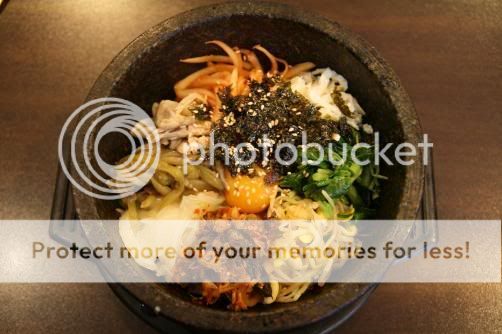
Bibim Bap 비빔밥 ( Rice with Beef and Mixed Vegetables )


Hello ~ Today, our special menu is called "Bibim Bap". It is Korea's famous food. It's main ingredient is rice. This is because rice is very important to Koreans.
There are two kinds of bowl in which you can use when eating Bibim Bap. The normal China (top) and the stone-made one (bottom). This helps a lot in keeping the rice hot and tasty.
Photobucket
Photobucket

Now, let us introduce to you the ingredients needed for this dish.
3 cups of rice
a handful of soy bean sprouts
4 dried shiitake mushrooms
1 zucchini ; sliced 1/4 inch thick
1/2 cup of mu (Korean Radish) ; julienne
1/2 cup of go sa ri (packaged fernbrake in water)
4 oz of beef ; thinly sliced
1/4 cup of carrot ; julienne
1/2 of onion ; sliced
4 tablespoon of gochujang (Korean Chili Paste)
4 eggs
sesame oil
vegetable oil for sautéing
Photobucket
soy bean sprouts seasoning:
1 tablespoon of sesame oil
1/4 teaspoon of gochugaru (Korean Chili Powder)
1/2 teaspoon of salt
1/4 teaspoon of sesame seeds
a pinch of sugar
shiitake mushrooms seasoning:
1/2 teaspoon of sesame oil
1/2 teaspoon of soy sauce
1/4 teaspoon of sugar

zucchini seasoning:
1 teaspoon of sugar
1 teaspoon of salt
1 teaspoon of sesame oil
1/4 teaspoon of minced garlic
1/4 cup of water
fernbrake seasoning:
2 tablespoon of vegetable oil
1 teaspoon of minced garlic
1/2 teaspoon of soy sauce
1 teaspoon of salt
1/2 teaspoon of sesame seeds

radish seasoning:
1 teaspoon of sugar
1 teaspoon of salt
1 teaspoon of sesame oil
1/4 teaspoon of minced garlic
1/4 cup of water
beef seasoning:
pinch of pepper
1 teaspoon of soy sauce
1 teaspoon of sugar
1/2 teaspoon of sesame oil
1/4 teaspoon of minced garlic

Steps in making Bibim Bap !
Wash rice until the water comes out clean. Add 3.5 cups of water, cook rice in a rice cooker. Or cook in a pot on a high heat until the water is absorbed. Reduce heat to very low, cover with a lid, cook for another 15-20 minutes. Turn the heat off, leave for 10-15 minutes with the lid on.
Marinate beef with seasonings.
Soy bean sprouts :
Wash and add to a pot, pour 1/2 cup of water and a pinch of salt, cover the lid. Bring to a boil, reduce heat to low, cook for 5-7 minutes. Don't peek it, if they smell like cooked beans, they're done. Pour into a colander, let cool for a while. Add seasonings, mix.
Shiitake mushrooms :
Dried ones need to be reconstituted, add warm water, leave until softened. Wash, squeeze out water, slice thinly. Add to a pan with seasonings, saute briefly.
Zucchini :
Add in a pan with seasonings on a high heat with a lid. Bring to a boil, reduce heat to low, cook for 2-3 minutes. Open the lid, let cool.
Fernbrake :
Drain the water, add oil to a pan, saute with seasonings. Add sesame seeds at the last minute. Let cool.
Carrot : Saute with some salt.
Saute beef on a high heat.

To assemble the bowl :
Put rice on a bottom, arrange vegetables around. Add egg york (or sunny side up, or just fried) on top. Serve with gochujang (Korean Chilli Paste) and sesame oil.

Photobucket

Photobucket
Photobucket

Photobucket
Tips :
You can use any vegetables such as spinach, bean sprouts, or mushrooms (oyster, enoki). Blanch mushrooms, squeeze, add some sesame oil, salt and sesame seeds.