4/18/2011

Aged Kimchi and Pork Belly 묵은지 삼겹살

Since we are back after a long pause of updates, this entry is to explain and emphasize one of the menus we introduced earlier in the previous blog below. The menu is called 묵은지 삼겹살 (Mook-eun-ji Sam-kyop-sal)

As you know, kimchi helps appetizing the meals and while eating with oily food such as pork belly, in this case, kimchi helps reduce the oil from the pork. However, the kimchi that are use in this menu are unique with special point, which we would like to point out to you ^^*

묵은지 (Mook-eun-ji) is known as an aged kimchi. Aged kimchi are simply kimchi that are fermented for a long period of time. Since in Korea, kimchi are widely eaten by Koreans in every meal, there is a period of time during winter that people would make kimchi. These aged kimchi are special kimchi that would get fermented throughout the winter days. All the seasonings are well absorbed into the vegetables and creates a strong taste.


Next time you think of eating pork belly, but don't forget to ask for 묵은지 :)

We're back with 3 Korean dishes!

Hello! Finally, after a long time, we are back ^^ Since it is our comeback entry, we would like to present to you three Korean menus! Some of the menus m
ight be familiar to you because they were already posted in our previous posts. However, we think it would be a good idea to once again, give an introduction to these mouth-watering dishes. So stay tune and let's explore the taste of Korea
along with us ;)

The first menu for today is called: 된장찌개 (Dwen-jang-ji-gye) Soy Bean Soup


It is a typical Korean dish, but the taste will never disappoint you in your hungry time! The ingredients for Soy Bean Soup are tofu, cucumber, spring onion, and soy bean paste. Its taste leads with a hot and spicy touch at the tip of your tongue. Followed by salty and sweet taste. It is indeed a great light choice of meal. You could simply have it with a bowl of hot steamed rice, and you are all set!


The next dish is called: 낙지소면볶음 (Nak-ji-so-myeon-bok-keum) Fried octopus with noodles


It might look very spicy in the picture above, but actually it isn't that scary. The red chili powder used in cooking doesn't bring much hot and spicy taste, just a glimpse. However, for people who are not fond of eating spicy food, there are noodles to help you get rid of the spicy flavor. The noodles itself is also a good accompaniment with the stir-fried octopus.


Last but not least, our third dish of the day: 묵은지 삼겹살 (Mook-eun-ji Sam-kyop-sal) Pork belly with aged Kimchi


As you can see, other than the pork belly, the are also kimchi being fried on the pan. This is a popular way of eating, which Koreans normally do for this menu. Kimchi helps make it more appetizing and it also helps reduces the oil from the pork while eating.


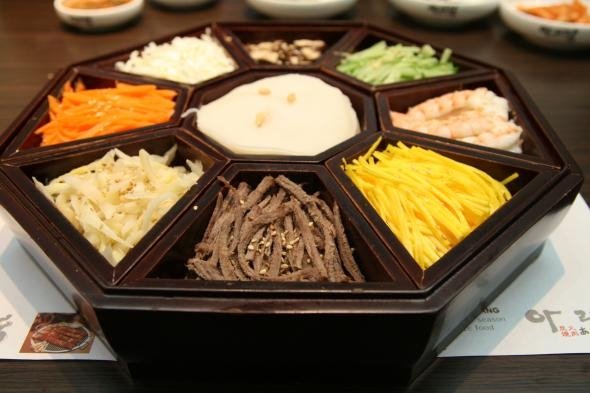
This is a picture of our table filled with yummy-looking Korean food ^-^ This was taken at a Korean Restaurant in Bangkok, Thailand.

We hope you enjoy our entry for today! Please look forward to our next entries that will surely be post soon! Thanks and don't forget to try some of these menus out ;) Ciao!
12/01/2009

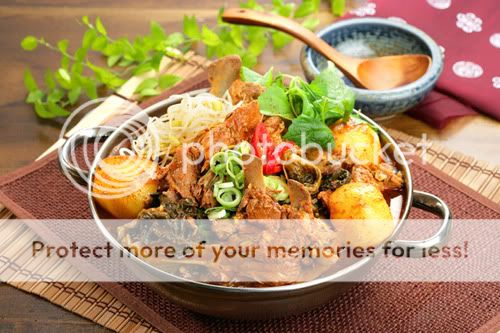
감자탕 Spicy Pork Stew with Potatoes

감자탕 or Gamjatang is a spicy pork bone stew that is considered a traditional Korean dish which is hearty and rich in flavors. In translation, the word “gamja” normally means potato in Korean but in this dish, it is actually referring to the pork bone itself. So unlike its name, the main ingredients are not potatoes but the hearty, complex taste of the rich broth which is made from boiled pork backbone. In full translation, this dish is called "pork bone stew" as “tang” means stew in Korean.
This stew is assorted with vegetables such as cabbage, mushrooms, parsley, green onions and bean sprouts. And it is heavily seasoned with garlic, red chili peppers and roasted perilla seeds. The additions of perilla seeds are optional as it gives a more delicate flavor to the dish, taking away the greasy taste of the pork. All gamjatang dishes may be similar in appearance, but the taste varies from one restaurant to another.


This dish is known to be rich in proteins, calcium and Vitamin B1 (from the pork bones) and is believed to prevent snoring as well as aging.
The steps in cooking 감자탕 might take a while, since we need to boil up the ingredients.
Get ready with all the ingredients, which includes potatoes, pork bones, parsley, spring onion, mushroom, cabbage, and bean sprouts.
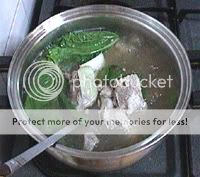
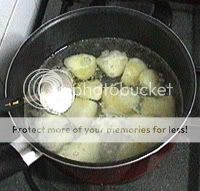
Later boil both the pork bones and potatoes.
Add all the ingredients in the pot with spicy soup and boil till it's ready to be serve.
Koreans usually drinks So-Ju along while eating 감자탕, especially in winter!!!!
CREDITS:

11/15/2009

김치냉장고 Kimchi Fridge

Kimchi Fridge is widely used in Korea nowadays, it helps ferment fresh kimchi at the suitable temperature so that the seasonings can permeate thoroughly into the main kimchi ingredients. This helps preserve kimchi longer without its taste being spoiled.
Kimchi should be stored at a low temperature. Around 5 C is the suitable temperature to maintain the best taste of kimchi. Right after the kimchi is finished fermenting, it may be left at room temperature for one day, and then stored in the refrigerator for further fermentation.

Alternatively, it may be stored in a specialized kimchi refrigerator to keep the original taste, it is something that has become very popular in Korea recently.

11/10/2009

오징어 덮밥‏ Stir-fried Octopus with Rice

오징어 덮밥‏ (O-Jing-O Top-pup) or Stir-fried Octopus with Rice is an easy to cook Korean dish. It can be made within a short time, which suit best for people who are busy and want to safe time cooking, but on the other hand want to find something delicious to eat. 오징어 덮밥‏ is definitely one of the first menus on the list for you!
To prepare for the cooking, you need octopus, chop it up into small pieces. Onions, carrot, spring onions, sugar, Korean chilli paste, Korean chilli powder, soy sauce, and sugar. After that you stir-fried the ingredients in the pan.
The taste of this dish is quite mild. This is because it is a bit sweet. However, it is also salty and hot. Depends mainly on the chilli paste and chilli powder you add into it.

11/07/2009

순대볶음 Stir-fried Korean Pork Sausage

순대볶음 or Stir-fried Korean Pork Sausage is a mouth-watering Korean dish. There's even a building in Korea selling only 순대볶음. People, usually adults, would enjoy having it with Soju (Korean liquor) while chatting along with each other.
Photobucket
The ingredients are as follow:
Soon-dae (Korean Pork Sausage)
Cabbage
Pork Intestine
Carrot
Onion
Grinded Sesame Seed
Vermicelli Noodles
Korean Chilli Sauce
Genip (A greenish vegetable)
Photobucket
When you cook, put all the ingredients in a pan and cook it until it is all mixed. Add the chilli sauce as much as you like. However, the more spicy it is, the more delicious it would be.
Photobucket
Genip, a type of vegetable, is use to put into the dish because it helps in making the smell of the sausage disappear, so the taste will be more mild.

11/02/2009

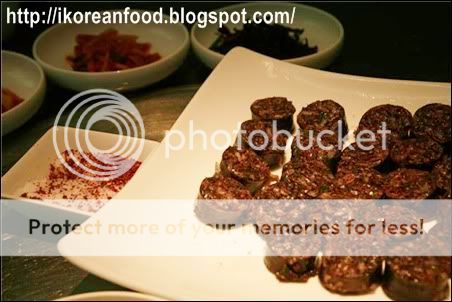
순대 Korean Pork Sausage

순대 (Soon-Dae) or Korean Pork Sausage is an all time favorite and popular appetizer. It is filled with both rice and vermicelli noodles, which are made form sweet potato. 순대 is a very common food in every Korean restaurants and also small vendors along the streets. Soon-Dae are served in soft, oval rolls.

Koreans, especially adults, love to have Soon-Dae with Soju or Korean liquor. And, there's also a seasoning that comes along with it, which is made up of salt, pepper, and chili power to add on some flavor to the sausage. Soon-Dae are usually eaten with side dish such as cubed radish kimchi, kaktugi.


10/16/2009

We're Back!

First of all, it had been a long long time since our last update. And, we would like to apologize for that hehe ^ ^ However, now that we have time because of work and studies that are likely settle, we will be back for some updates about Korean food once again!

Anyway, today let's have a look at some mouth-watering pictures ... Thank you google.co.th ^ ^


2/07/2009

Cinnamon and Ginger Tea With Persimmons 수정과

Soojunggwa or 수정과 is a traditional Korean drinks. It existed since the Chosun Kingdom. Koreans usually drink it after meals. The aromatic scent of ginger can bring relaxation. Now, a beverage company in Korea produced Soojunggwa in a can, so it's easier to drink. However, the original taste is still there !

Photobucket

Ingredients

10 cinnamon sticks
5 - 6 pieces of ginger
10 cups of water
2 cups of sugar
1/4 cup of pine nuts
10 dried persimmons (gotgam)

Photobucket

Procedures

Add water, cinnamon sticks, and ginger into a big pot.
Wait for it to boil for about 1 - 2 hours.
Add sugar. (This depends on how sweet you want it to be)
Let cool for a while, then put it in the refrigerator.
Serve with persimmon inside and some pine nuts on top.

Photobucket

2/05/2009

Culture Capsule 10

Don’t call someone older than you by their first name.

People don’t speak in the first person in Korea. We don’t often use the pronoun ‘you’ either, especially to someone older than you. While you can use the name of a younger brother/sister or a friend of the same age, you can’t use your colleague’s name, boss’s name or the name of someone you don’t know well. In the family or at school, girls can call an older brother, older male friend ‘오빠’ and boys can use ‘형’. Likewise, girls can call an older sister, older female friend ‘언니’ and boys can use ‘누나’. In the office, it’s a good idea to add ‘님’ to the last name and job title of all older people. Among colleagues, they add ‘씨’ after a man or woman’s full name.

- Write reference Korean Languge Education Center, Sogang University

1/31/2009

Cha-Chang-Myeon 자장면‏

.
Photobucket
.
Cha-Chang-Myeon is a kind of noodles, which is very popular in Korea, especially among children. Cha-Chang-Myeon has a mixture of both Korean and Chinese food. You can try tasting the original one at the China Town located in Incheon.
.
Photobucket
.
How to Cook :
.
The Sauce
1. In a pot, put in a small amount of oil, pork, spring onion, ginger, onion or you can also put in some garlics.
2. Stir the ingredients together until they are cooked.
3. Add Joong-Kook-Twen-Jang (Chinese Bean Paste), cooking liquor, soup, and wait for it to boil.
.
Photobucket
.
When serving, you just have to pour the sauce onto the noodles and mix it well.
.
Photobucket
.

1/28/2009

Mandoo guk 만두국(Korean dumpling soup)

Mandoo guk is a food from China.

Korea kneads mainly plentifully from region north Seoul.


Ingredients:
20 dumplings, 4 oz beef, 2 green onions

1/8 teaspoon soy sauce, 1/8 teaspoon sesame oil

salt, pepper, 6 cups water, 1 egg, mixed

1 sheet seasoned gim (dried seaweed, nori), crushed


How to Cook:

Put a pot on a medium heat stove.
When the pot gets hot, saute beef with soy sauce and sesame oil.

Add water, bring to a boil.


Put dumplings in.

Cook for 3-4 minutes just before dumplings cooked completely.

Add green onions.

Season with salt and pepper.


Spread egg, don't stir immediately.


Put in a bowl.

Garnish with kim.

1/26/2009

Culture Capsule 9

Hanbok

Honbok, the Korean traditional dress, has been handed down in the same form unchanged for hundreds of years because it is well suited to the Korean climate and culture. The man's basic outfit consists of a jeogori(jacket), baji(trousers), and durumagi (overcoat).
The jacket has loose sleeves and the trousers are roomy and tied with straps around the ankles. The woman's has includes a jeogri(short jacket) with two long ribbons, which are tied to form the otgorum, and has long full sleeves and a full length, high-waisted wrap around skirt called the chi'ma. White cotton socks and boat-shaped shoes, made of silk, straw, or rubber, are worn with this clothing.


- Write reference Korean Languge Education Center, Sogang University

1/24/2009

Stir-Fried Squid 오징어 볶음

.
오징어 볶음 (O Jing Ngo Bok Kum)
.
Photobucket
.
Ingredients :
Squids
Chopped Onions ; about 2-3 inches
Chilli
Spring Onions
Chopped Carrot ; thin stripe
Korean Mushroom ; similar to Shitake Mushroom
Gochujang ; Korean Chilli Paste
Gochugaroo ; Korean Chilli Powder
Soy Sauce
Sugar
Sesame Oil
Sesame Seeds
Garlic
.
Photobucket
.
How to Cook :
1. Clean the squids and cut it into pieces about 3 inches.
2. Then mix all the ingredients up together ; squids, vegetables, and seasonings.
3. Leave it for about 10 minutes for the seasonings to absorb into the squids.
4. Then later in a pan, stir-fried the squids for about 3-4 minutes or until it is cooked. Remember not to turn on the fire to high because the squids could be burned. And, if you use too low, the squids won't be crispy.
.
This menu won't take long to cook !
And, the taste is sweet and spicy in one dish.
.

1/21/2009

Kimchi Roe Rice 김치알밥

Kimchi Al Bup is similar to Bibimbup. However, the main ingredients, which made it different are Kimchi and Roe.
.
Photobucket
.
Ingredients
Kimchi
Roe
Onion
Pumpkin
Carrot
Mushroom
Sesame Oil
Sesame Seeds
Egg
Gochujang (Korean Chilli Paste)
.
Photobucket
.
How to Cook
First, you need to chop the Kimchi and stir in it a pan.
Second, chop all the vegetables we've prepared and do the same with the Kimchi.
Actually, for this step, you can do it at the same time or stir them separately.
Okay, next, in a stone bowl, put in the rice.
Follow by the Kimchi and vegetables along the side of the bowl.
This bowl will help keeps it warm, and this is the key point ! Korean people love it hot !
Put on top a fried egg and roe.
When eating, add some Gochujang and sesame oil for better taste.
Mix everything up in the bowl, and it's time to eat !
The crispy feeling of the roe and kimchi will add taste to the dish !

1/19/2009

Culture Capsule 8

What's in a Korean Name

Typically, a Korean name consists of a family name and a given name which is typically made up of two Chinese characters. For instance, take a common Korean name such as 'Kim Yeong Su'. Here 'Kim' is the family name and 'Yeong Su'is the given name.

Traditionally, when parents select a child's given name in Koream the given name is derived from two Chinese characters. One Chinese characters is affixed according to generation so that brothers, sisters and cousins would have the same Chinese character. The second Chinese character would be individually selected by the parents. Based upon two Chinese characters, a child would receive his given name. However, many modern Korean parents have chosen a different method in selecting their child's given name. Instead of selecting their child's given name via the use of Chinese characters, many Korean parents have chosen to select pure Korean names without any reference to Chinese characters.

Currently, there are approximately 90 family names in Korea. Some of the most common family names in Korea are Kim, Lee, Park, and Choi. In most western countries, after a woman marries she legally adopts the husband's family name as her own. However in Korea, a woman maintains her family's name throught her life.


-Write reference Korean Languge Education Center, Sogang University

1/17/2009

Kimchi Jim 김치찜

Kimchi Jim is a kind of Korean dish, which is usually eaten with So-Ju (Korean liquor) and beer.
Photobucket
The main ingredients are Kimchi and pork.
For this menu, Kimchi Jim, 찜 (Jim) means steam. So, in order to make this dish, you have to first, take the Kimchi and steam it. After that, we come to the pork. It's important of which part you use. The most suitable is at the neck. Take it and mix with some seasoning.
Photobucket
How to Eat :
1. Pick up one Kimchi
2. Put a piece of pork on it
3. Warp the Kimchi up, and enjoy the delicious taste !
You can also eat it with rice ~

1/16/2009

Soondooboo jjigae 순두부 찌개 (Soft tofu stew)

Sundubu jjigae is a hot and spicy jjigae (Korean stew).
This dish is eaten with a bowl of cooked white rice and several banchan (side dishes).
It is widely eaten and one of the favorite meals in South Korea.


Photobucket


Ingredients:
1 pack soon doo boo (soft tofu)*
8 small clams - cleaned, 4 ounce pork (or beef) - sliced
1/4 cup kimchi - roughly chopped, 1 red hot chili - sliced
2 green hot chilies - sliced, 2 green onions - sliced
1 egg york, 1 tbsp go choogaroo (Korean chili powder)
1 tbsp vegetable oil, 1 tsp minced garlic, 1/2 tsp juice of ginger
1 tsp soy sauce, 1/2 tsp sesame oil
1 tsp sae woo jeot (salted shrimp)**
3 cups water

(*It is in a tube, different from square package soft tofu in a Korean super market.)

(**Salt can be used.)


Photobucket


How to cook:

Marinade pork with ginger juice, soy sauce, sesame oil and minced garlic.

In a pot, add vegetable oil and saute pork.
Add go choo ga roo (Korean chili powder), keep stir.

Add water and kimchi, bring to a boil.

Scoop in soon doo boo with a spoon.

Reduce heat, add sae woo jeot (salted shrimp).

Add chillies, green onions and clams.
Cook for a minute or so.

Finish with egg york in the center and a dash of sesame oil.

Serve with rice.